
Vision & Mission
We bridge markets.
From Hamburg to wherever your business goes, including the destinations most banks won't touch.
From Hamburg to wherever your business goes, including the destinations most banks won't touch.
German businesses pay suppliers in Vietnam, Turkey, Angola, Pakistan. They settle invoices in Buenos Aires, Mumbai, Lagos. The payment infrastructure they rely on was built for institutions, and pretends the rest of the world ends at the SWIFT corridor. HansePay closes that gap. We bridge German businesses to the markets they actually trade with, including the ones banks call "exotic" and quietly avoid.
Our mission is simple to state and demanding to execute: take the friction out of cross-border payments for the German Mittelstand. Connect people. Simplify complexity. Reduce barriers. The infrastructure does the technical work; we do the bridging.
This is also a question of European sovereignty. The infrastructure routing most German cross-border payments today was designed half a century ago and runs through a small set of dominant correspondent banks, mostly outside the EU's direct regulatory reach. HansePay is the alternative. EU-regulated, Hamburg-operated, designed so German businesses have an independent route to the markets they actually trade with, including the corridors others have priced out of reach.

Our logo is a bridge. Not a metaphor we chose later: the shape itself. Hamburg has more bridges than Venice and Amsterdam combined, and every one of them does the same job. It lets something on one side reach something on the other. That is what HansePay does, in financial form. It bridges the German business to its counterparty, the EUR account to the foreign currency, the present moment to the moment the money lands.
The bridge in our logo is historical in form, modern in function. Built today, regulated under European law, engineered for cross-border payment volumes the original Hanseatic merchant could not have imagined. The shape is from 1241. The infrastructure is from 2026.
In 1241, Hamburg and Lübeck signed the founding agreement of the Hanseatic League, a network of merchant guilds that came to dominate trade across the Baltic and the North Sea for nearly four centuries. At its peak, the Hanse connected around 200 trading cities across Europe, from Novgorod to London, from Bergen to Bruges. It made Hamburg one of Europe's first global cities. Its merchants moved goods, money, and credit across borders long before there was a euro to convert.
HansePay is a deliberate inheritance from that lineage. The name binds us to a way of doing business: precise, discreet, long-term, and quietly competent. The Hanseatic merchant didn't shout. He delivered. We try to do the same.
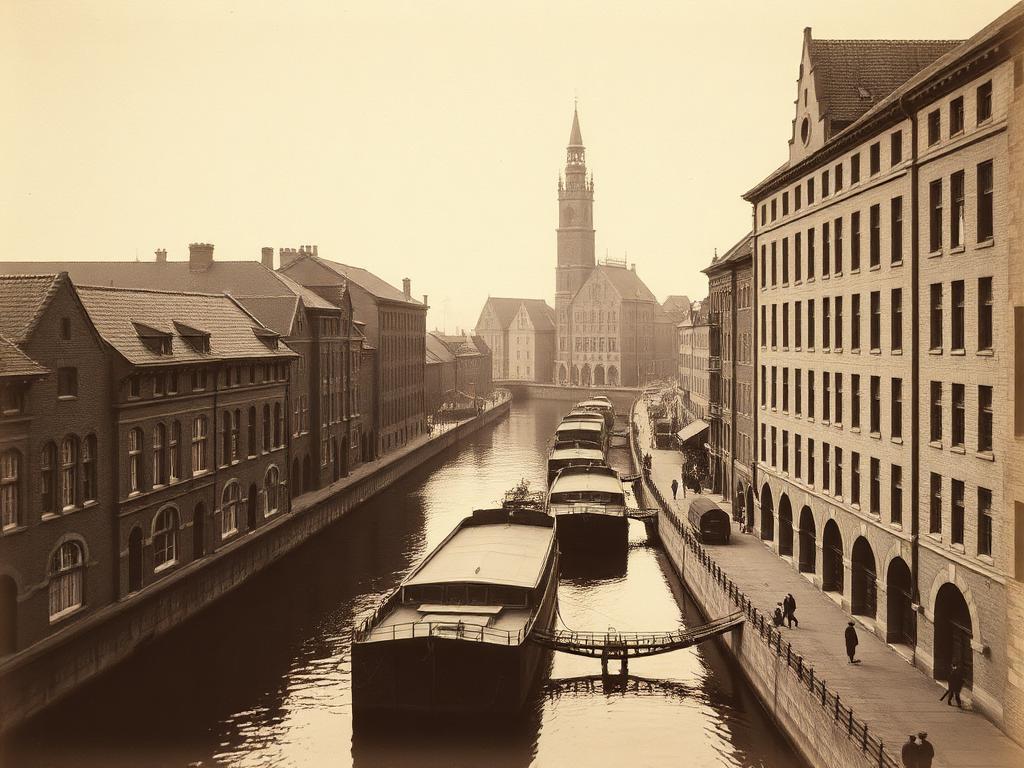
For 750 years, Hamburg has been Germany's port to the world. The Elbe doesn't stop at the city limits. It carries goods to and from every continent. That makes Hamburg unique among German cities. It is local, but its identity is global. It is rooted, but its work is outward-facing.
Every German export that travels by sea, and most that travel by air, passes through Hamburg or its logistical neighbors. The city is the country's gateway in both directions. It brings the world to Germany, and it carries Germany out into the world. Inbound. Outbound. The bridge works both ways.
HansePay sits in that tradition deliberately. We are headquartered in Hamburg because the city's history is the same history our customers are participating in. Where bridges have always stood, trade has always followed.
The dominant cross-border payment network, SWIFT, was designed in 1973 by a consortium of 239 banks across 15 countries. It was a triumph of its era: a standardised messaging protocol that let banks send payment instructions to each other across borders. Half a century later, those instructions still hop through three to five correspondent banks before they arrive at the recipient. Each hop adds a fee, a foreign-exchange spread, and a delay measured in days.
That model was state-of-the-art in 1973. By 2026, the world had changed. E-commerce platforms settle in milliseconds. AI agents transact autonomously. German businesses pay suppliers in markets the original SWIFT cooperative had never imagined reaching. A modern alternative wasn't a luxury. It was overdue.
HansePay is that alternative. Built on regulated digital money infrastructure, the E-Money Token framework established by MiCAR in 2024, it settles cross-border in minutes, not days, at a fraction of the cost. The technology underneath is new. The discipline of the business is centuries old.
Hamburg and Lübeck establish the trade alliance that connects 200 cities across Europe.
239 banks build the cross-border messaging protocol that still routes most international payments today.
The EU establishes the legal framework for regulated digital money, including E-Money Tokens.
A European, regulated, modern cross-border payment platform built for the businesses SWIFT was never designed to serve.
The principles behind every decision we make, and everything we build.
Every product decision, every commercial conversation, every line of code, answers to a customer outcome. Internal cleverness that doesn't reach a customer doesn't count.
Integrity is standing by what we say and keeping the promises we make. Transparency is how we practise it: the rate you see is the rate you get, the fee disclosed is the fee charged, and every confirmation matches its settlement. No small print, no exceptions for the inconvenient cases.
European independence is not a marketing line. It is a structural design choice. We reduce reliance on American and other foreign FX infrastructure, keeping European businesses on European rails through every regulatory, technology, and operational decision we make.
HansePay is part of the German and European finance and fintech ecosystem, by membership, by audit relationship, and by professional standing.
Active member of the European payments community.
Funding partner for Hamburg-based fintech innovation.
Member of the Hamburg financial centre initiative.
Member of the European fintech community.
Audit and advisory partner.
Cloud and infrastructure partner.
Member of the Hamburg Chamber of Commerce.
Start sending money in minutes, or talk to us about your use case.